Wall & Drywall Water Damage Restoration
Wet drywall and the stud bay behind it have specific moisture thresholds and salvage windows. The decision about what comes out and what dries in place is driven by meter readings, not guesswork — and the difference between the two decisions is thousands of dollars in reconstruction cost.
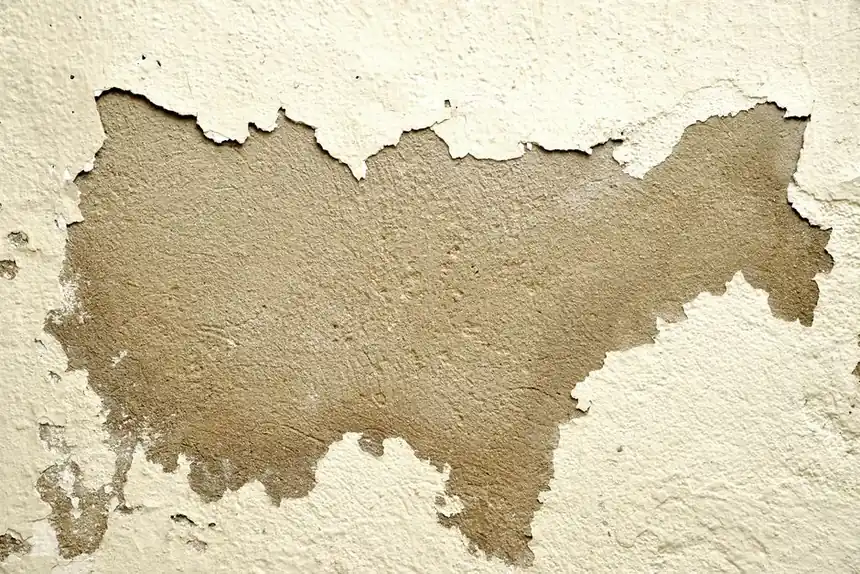
How water moves through wall assemblies
Water in a wall is rarely a surface problem — it's a cavity problem. A supply line leak behind a kitchen wall sends water into the stud bay where it saturates the batt insulation, wets the back side of the drywall (which looks fine from the room side for hours), tracks down the stud bay by gravity, soaks the bottom plate, and migrates through nail holes or wire penetrations into adjacent cavities and under baseboard trim. The visible stain on the face of the drywall is often the last place water reaches, not the first.
This is why wall restoration starts with inspection, not demolition. Our job is to find every affected cavity, measure the moisture content of the materials in each one, and make targeted decisions about what to remove and what to dry.
The flood cut — our most common wall-damage decision
A "flood cut" is a horizontal cut through the drywall at a fixed height above the floor — typically 16 or 24 inches — with the lower section removed. We use it when:
- Water migrated up stud bays from a floor-level source (burst pipe, basement flood)
- Batt insulation in the lower stud bay is saturated and must come out
- The bottom plate needs access for drying
- Drywall moisture readings at the base exceed the dry standard
Flood cutting is faster and less expensive than removing full sheets of drywall, and it gives us access to dry everything in the lower cavity. Reconstruction is a lower-strip replacement that can match the existing texture if done carefully.
Full-sheet removal — when we do it
Full sheets come out when:
- Water came from above (ceiling leak tracking down into walls) and saturation extends up
- Mold has established in the cavity (past 72 hours in warm conditions)
- Texture or paint match of a lower-strip repair would be visually unacceptable (dark colors, specialty texture, high-visibility walls)
- The drywall has delaminated or crumbled on handling
Insulation decisions
Fiberglass batt insulation that's taken on water doesn't dry back out usefully. It compacts, loses R-value, and holds moisture indefinitely, which keeps the stud bay wet and promotes mold. Standard protocol is removal and replacement. Blown cellulose behaves similarly. Closed-cell spray foam doesn't absorb water the same way and can usually stay.
Framing and base plate
Studs and bottom plates are usually dryable in place with air movement into the open cavity. We meter them directly with pin meters and dry to a documented target. Framing rarely needs replacement after a short-duration burst-pipe loss; it may need replacement after a long-duration gradual leak where rot has set in.
Related services
Burst Pipe Damage
Parent service.
Ceiling Damage
Related assembly.
Hidden Moisture
Finding wet cavities.
Structural Drying
Cavity drying.
Pipe Leak Restoration
Hidden-leak wall damage.
Reconstruction
Drywall replacement.